

Nobody's Muse
On portraiture, likeness, and the muse.

When I was in preschool, the teachers did a portrait project and cut our image in silhouette, a practice that was most popular in the 1800s. The form is classic, like a cameo. I still have the portrait today.
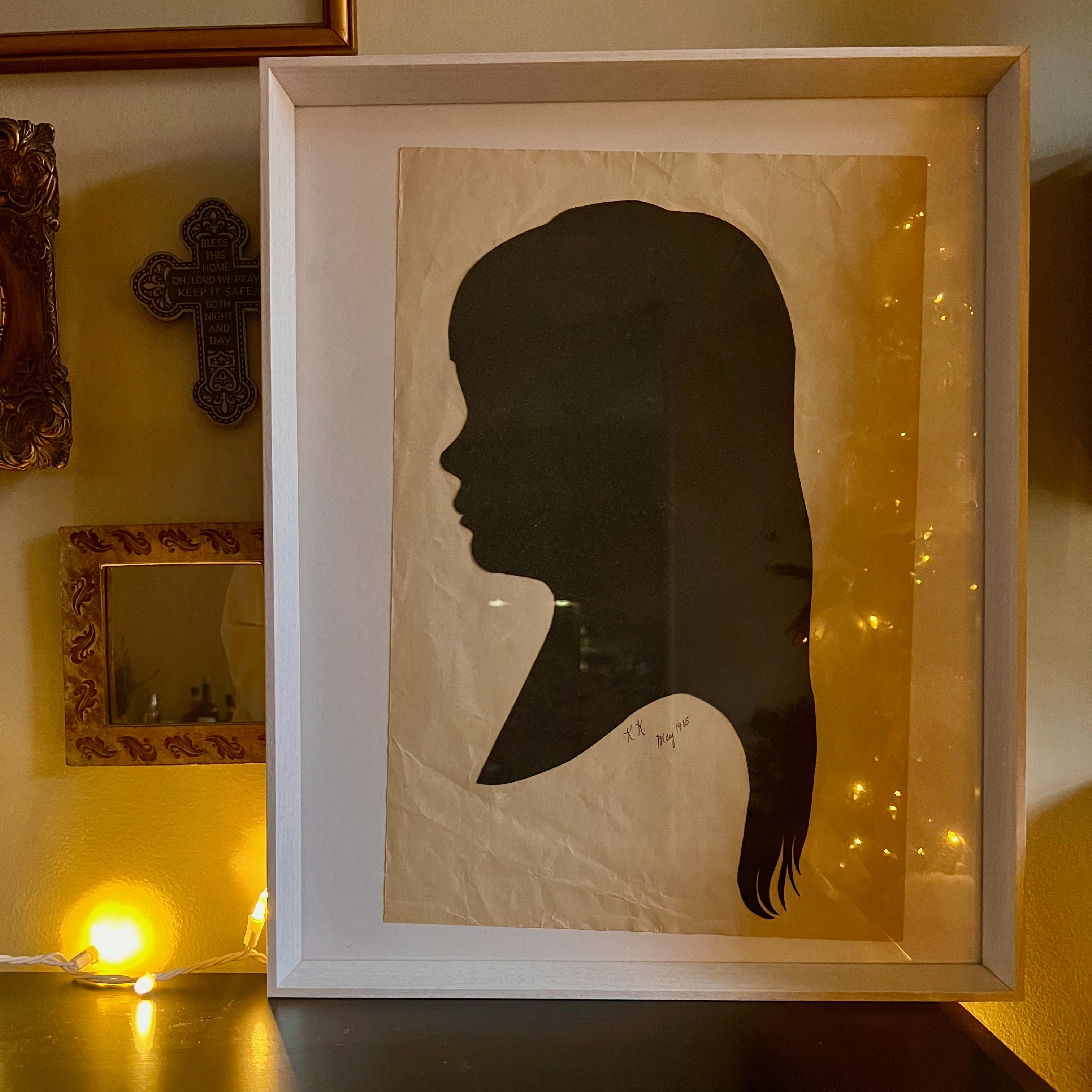
It’s marked May 1985, which means I was fresh of five years old.
This is also the first time I recall disliking my own image. My forehead was too big. A receded chin? I’m not sure when, exactly, I had these thoughts. Immediately? Over the years? The fact still remains.
The silhouette portrait lost popularity with the invention of the photograph. Still, many of us hate our own image in photos. My sister owns - reader, OWNS - a headshot photography business and wrote a blog post entitled: Why I Don't Want a New Headshot. The psychology of this phenomenon is based around the idea that we prefer the familiar. When we look at ourselves in a mirror, we see our mirror image, not what is projected in a photo. Not to mention that photography is notoriously tricky for accurately capturing our image anyway.
But that has gotten me thinking about portraiture and art. One of my heroes is a woman name Francoise Gilot. She died in 2023 at the age of 101. She was one of Picasso’s romantic parters and mother to two of his children. Most notably, she was the only woman who ever left him.
She wrote an autobiography called, Life with Picasso, published in the 60s, though Picasso fought her over its publication in court. She later married Jonas Salk, developer of the first safe polio vaccine. She was an artist in her own right, painting up until her death. I am not alone in finding her fascinating. Her memoir was a primary source for the Discovery Channel’s mini series: Genius: Picasso.
But I had a recent brush with her that had me honestly swooning.
In March 2024, my family traveled to the Netherlands to visit my friend who lives in Maastricht. We just happened to be there the same week as a popular art fair. That’s what my friend called it: an “art fair.” I’m not sure what else one could call it. There are booths and vendors and art for sale. However, it’s a gathering of the top galleries in the world, selling privately owned pieces by the greats, such as Renoir, Dali, Kandinsky, Warhol, Rodin, Munch, Titian, Degas, and yes, Pablo Picasso.


I love art. I’m self-taught in art history, and I will go to whatever is the acclaimed art museum in a town (so impressed with Kansas City’s Nelson-Atkins, by the way). I wander and read and stare until my back hurts. I never pass up the audio tour.
In the Netherlands, we certainly visited the Rijksmuseum and Van Gogh. I’ve been to the Capitoline Museums in Rome (see also, the city of Rome itself, one big museum), the Vatican, the Alte Pinakothek in Munich, the Prado in Madrid, El Greco in Toledo, The Met, MOMA, Art Institute, and one of my favorites, The Dali Museum in St. Petersburg, Florida.
I say all this because as a writer, I enjoy enjoying visual art for the sake of enjoying art. Unlike in writing, I have no desire to contribute to the conversation of art. And there is a complete release in that. A complete freedom to absorb and learn and be filled.
This “art fair” in Maastricht is called, TEFAF, and it was a unique experience, because the pieces I was seeing were up for sale. Most likely transferring from one private collection to another, they may never be seen again. At least by me. Had I known this was what the “art fair” truly was, I might have worn nicer shoes.
After seeing a Picasso or two, I did start to hope that I might see her. You know, HER. And I was not disappointed. I rounded a corner, and there she was.


Francoise. My day was made.
So when I came across the second Francoise, I truly couldn’t believe my luck.
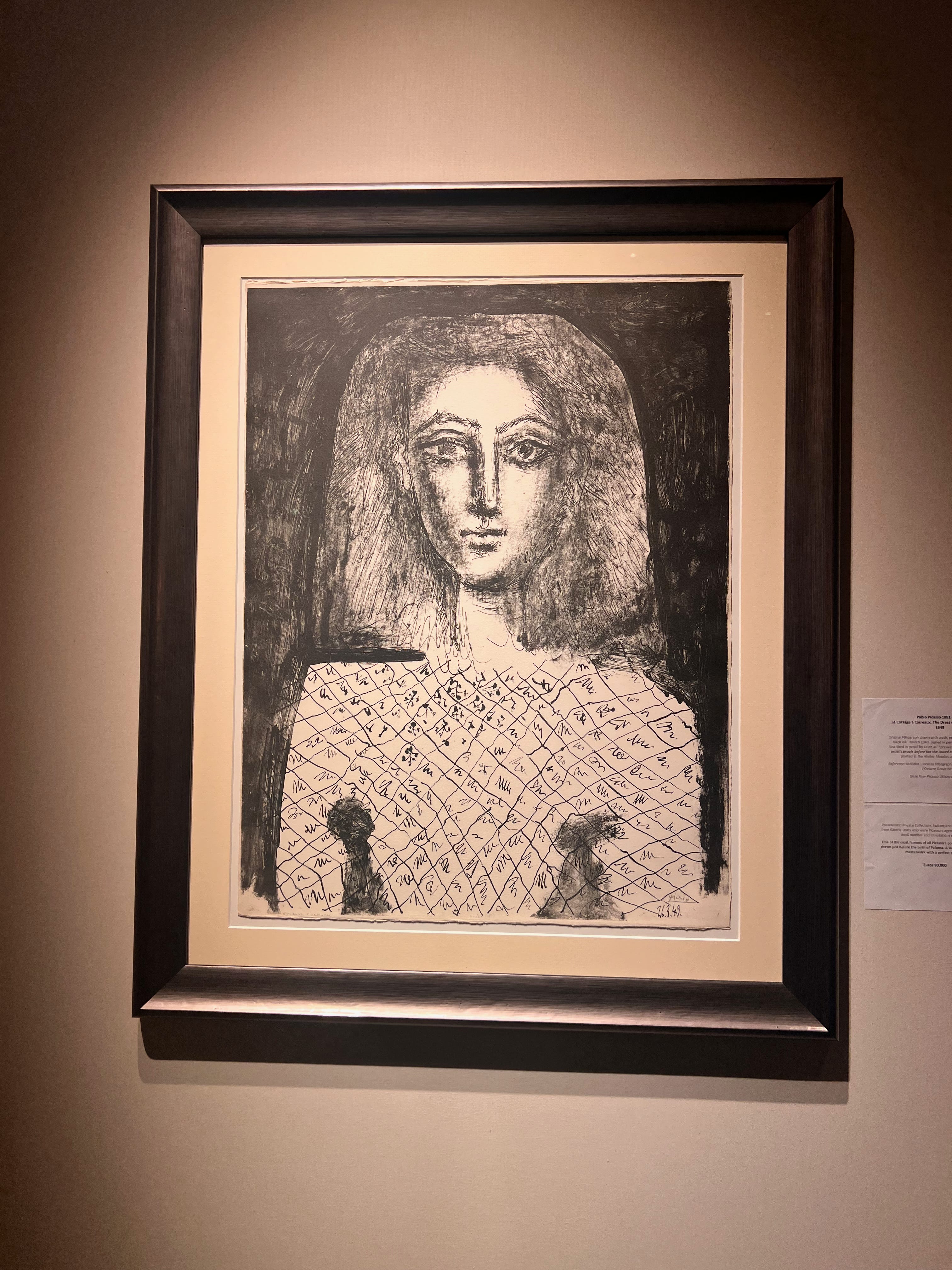
This portrait took my breath away. It is just stunning. If I had had the 90,000 euros, she would have gone home with me.
Though she was often called a “muse,” I no longer romanticize that word after seeing an exhibition of Lee Miller’s work at the Dali museum and reading a fantastic book that explores the often tragic role of being a muse.
It’s called: Farewell to the Muse: Love, War, and the Women of Surrealism
A must read. It explores how being a muse came along with emotional trauma and chaotic relationships, all for the advantage of the male artist’s process. Many of these “muses” were artists in their own right, but were overshadowed by the men. No news here, really. But so many, like Dora Maar, Picasso’s romantic partner before Francoise, ended up some version of heartbroken.
Lee Miller, who lived a completely amazing life as a war journalist and photographer, began her life as her father’s muse, who would have her pose for nude portraits. (Yeah. You read that right.)

Lee is probably most famous for taking a bath in Hitler’s tub shortly after he killed himself. She was dirty from all of her war travel, and she decided to hop on the opportunity to clean up.

You can read about that here: "When Lee Miller Took a Bath in Hitler's Tub"
She documented some of the first photographic evidence of the Holocaust.
In Lee’s work on display, I think every woman I saw had slept with Picasso at some point. That is not an exaggeration.


The first photo is of Dora Maar, a photographer, poet, and painter, she documented Picasso’s creation of Guernica. She was tortured in her relationship with Picasso, suffering a nervous breakdown when he left her for Francoise. She struggled with her mental health for years after.
The second photo is Lee Miller and Picasso. Yes, they slept together in some sort of it’s-all-good-among-friends way. Though Lee Miller was married to Roland Penrose. Their marriage was troubled by affairs, depression, alcoholism, and post traumatic stress disorder, for all that Lee had witnessed and endured.
The third photo shows Francoise peeking over Picasso’s shoulder.
I, of course, sought Francoise in the other photos:


Sure, I’m a little obsessed. You could be, too, after watching this: Sunday Morning interview with Francoise, recorded in 2017. She was 95. In the interview, she discusses leaving Picasso. He didn’t think she would do it. But the day she left him, he only said one word: “mad.”
When she married Dr. Jonas Salk, it was under the condition that they only spend half the year together. She was an artist, after all, and she understood, after the years with Picasso, how important it was to protect that.
In her memoir, she wrote: “[Picasso] burned all the bridges into the past I had shared with him. But in doing so, he forced me to discover myself and survive.”
Francoise Gilot is a VIBE. I am obsessed with her complete badassness. She’s my inspiration because she lived an accomplished life beyond her likeness in Picasso’s portraits. She’s my inspiration because she ain’t nobody’s muse.
I love that silhouettes started you on such an artistic exploration!